Sunday, November 23, 2008

Rob Walton mistaken for Rob Walton!


Did this man create Chocolate-Face Grace?

Check this out while it lasts! chairman of the board Rob Walton of WalMart gets credited for creating the new web comic Chocolate-Face Grace! Couldn't hurt sales now, could it? Also posted on this page is CEO Rob Walton's sterling lunchtime conversation with Comics curmudgeon Dave Sim!

Friday, November 21, 2008

Why Aren't You Reading This?


Sorry I haven't been around lately. I've been busy with Chocolate-Face Grace of course, as well as making a living. I really wanted to take a moment to tell you about Jason Aaron's Ghost Rider for Marvel. I've been familiar with Aaron's work for Vertigo (Scalped in particular), but his work for Marvel has come as a complete and exhilarating surprise. What is this? 1972? Aaron is producing an old school retro-periodical that has all the excitement of Marvel's hay days. It's simple, uncomplicated storytelling and a Hell-of-a-lotta fun. Issue 29 is just out this week along with a trade of issues 20-25. Check out the art of Roland Boschi, a strange combination of Kevin O'neil and Bernie Wrightson. Give it a try.

Monday, October 27, 2008

Chocolate-Face Grace


I'm pleased as all punch to announce that Chocolate-Face Grace is now on the WWW! Grace and I have been collecting and writing stories for a few months now and I've finally gotten down to drawing the strips. It's all a grand experiment in storytelling and having fun and doing whatever it takes to get you through the day. Enjoy!

Tuesday, October 7, 2008

The Prophet Speaks

I have read several of Prof. Gray's books in the past few months, all of them illuminating and shockingly informative. His general thesis that modern politics is another chapter in the history of Utopian religion and that a globalized free market was historically doomed to failure (least of all because as he wrote in 1998 "Democracy and the free market are rivals, not allies.") rings true in light of current events which Gray predicted ten years ago in his book False Dawn: The Delusions of Global Capitalism. Gray's writings fill in historical gaps in the writings of progressive gadflies like Chomsky and explain historically such things as the drive toward Western hegemony which is a natural prerequisite to a global free market as global economic insecurity is a consequence. "At the global level, as at that of the nation-state, the free market does not promote stability or democracy. Global democratic capitalism is as unrealizable a condition as world-wide communism." False Dawn pg. 21.

The article below doesn't exactly say I told you so, but...

A shattering moment in America's fall from power

The global financial crisis will see the US falter in the same way the Soviet Union did when the Berlin Wall came down. The era of American dominance is over

Our gaze might be on the markets melting down, but the upheaval we are experiencing is more than a financial crisis, however large. Here is a historic geopolitical shift, in which the balance of power in the world is being altered irrevocably. The era of American global leadership, reaching back to the Second World War, is over.

You can see it in the way America's dominion has slipped away in its own backyard, with Venezuelan President Hugo Chávez taunting and ridiculing the superpower with impunity. Yet the setback of America's standing at the global level is even more striking. With the nationalisation of crucial parts of the financial system, the American free-market creed has self-destructed while countries that retained overall control of markets have been vindicated. In a change as far-reaching in its implications as the fall of the Soviet Union, an entire model of government and the economy has collapsed.

Ever since the end of the Cold War, successive American administrations have lectured other countries on the necessity of sound finance. Indonesia, Thailand, Argentina and several African states endured severe cuts in spending and deep recessions as the price of aid from the International Monetary Fund, which enforced the American orthodoxy. China in particular was hectored relentlessly on the weakness of its banking system. But China's success has been based on its consistent contempt for Western advice and it is not Chinese banks that are currently going bust. How symbolic yesterday that Chinese astronauts take a spacewalk while the US Treasury Secretary is on his knees.

Despite incessantly urging other countries to adopt its way of doing business, America has always had one economic policy for itself and another for the rest of the world. Throughout the years in which the US was punishing countries that departed from fiscal prudence, it was borrowing on a colossal scale to finance tax cuts and fund its over-stretched military commitments. Now, with federal finances critically dependent on continuing large inflows of foreign capital, it will be the countries that spurned the American model of capitalism that will shape America's economic future.

Which version of the bail out of American financial institutions cobbled up by Treasury Secretary Hank Paulson and Federal Reserve chairman Ben Bernanke is finally adopted is less important than what the bail out means for America's position in the world. The populist rant about greedy banks that is being loudly ventilated in Congress is a distraction from the true causes of the crisis. The dire condition of America's financial markets is the result of American banks operating in a free-for-all environment that these same American legislators created. It is America's political class that, by embracing the dangerously simplistic ideology of deregulation, has responsibility for the present mess.

In present circumstances, an unprecedented expansion of government is the only means of averting a market catastrophe. The consequence, however, will be that America will be even more starkly dependent on the world's new rising powers. The federal government is racking up even larger borrowings, which its creditors may rightly fear will never be repaid. It may well be tempted to inflate these debts away in a surge of inflation that would leave foreign investors with hefty losses. In these circumstances, will the governments of countries that buy large quantities of American bonds, China, the Gulf States and Russia, for example, be ready to continue supporting the dollar's role as the world's reserve currency? Or will these countries see this as an opportunity to tilt the balance of economic power further in their favour? Either way, the control of events is no longer in American hands.

The fate of empires is very often sealed by the interaction of war and debt. That was true of the British Empire, whose finances deteriorated from the First World War onwards, and of the Soviet Union. Defeat in Afghanistan and the economic burden of trying to respond to Reagan's technically flawed but politically extremely effective Star Wars programme were vital factors in triggering the Soviet collapse. Despite its insistent exceptionalism, America is no different. The Iraq War and the credit bubble have fatally undermined America's economic primacy. The US will continue to be the world's largest economy for a while longer, but it will be the new rising powers that, once the crisis is over, buy up what remains intact in the wreckage of America's financial system.

There has been a good deal of talk in recent weeks about imminent economic armageddon. In fact, this is far from being the end of capitalism. The frantic scrambling that is going on in Washington marks the passing of only one type of capitalism - the peculiar and highly unstable variety that has existed in America over the last 20 years. This experiment in financial laissez-faire has imploded.While the impact of the collapse will be felt everywhere, the market economies that resisted American-style deregulation will best weather the storm. Britain, which has turned itself into a gigantic hedge fund, but of a kind that lacks the ability to profit from a downturn, is likely to be especially badly hit.

The irony of the post-Cold War period is that the fall of communism was followed by the rise of another utopian ideology. In American and Britain, and to a lesser extent other Western countries, a type of market fundamentalism became the guiding philosophy. The collapse of American power that is underway is the predictable upshot. Like the Soviet collapse, it will have large geopolitical repercussions. An enfeebled economy cannot support America's over-extended military commitments for much longer. Retrenchment is inevitable and it is unlikely to be gradual or well planned.

Meltdowns on the scale we are seeing are not slow-motion events. They are swift and chaotic, with rapidly spreading side-effects. Consider Iraq. The success of the surge, which has been achieved by bribing the Sunnis, while acquiescing in ongoing ethnic cleansing, has produced a condition of relative peace in parts of the country. How long will this last, given that America's current level of expenditure on the war can no longer be sustained?

An American retreat from Iraq will leave Iran the regional victor. How will Saudi Arabia respond? Will military action to forestall Iran acquiring nuclear weapons be less or more likely? China's rulers have so far been silent during the unfolding crisis. Will America's weakness embolden them to assert China's power or will China continue its cautious policy of 'peaceful rise'? At present, none of these questions can be answered with any confidence. What is evident is that power is leaking from the US at an accelerating rate. Georgia showed Russia redrawing the geopolitical map, with America an impotent spectator.

Outside the US, most people have long accepted that the development of new economies that goes with globalisation will undermine America's central position in the world. They imagined that this would be a change in America's comparative standing, taking place incrementally over several decades or generations. Today, that looks an increasingly unrealistic assumption.

Having created the conditions that produced history's biggest bubble, America's political leaders appear unable to grasp the magnitude of the dangers the country now faces. Mired in their rancorous culture wars and squabbling among themselves, they seem oblivious to the fact that American global leadership is fast ebbing away. A new world is coming into being almost unnoticed, where America is only one of several great powers, facing an uncertain future it can no longer shape.

• John Gray is the author of Black Mass: Apocalyptic Religion and the Death of Utopia (Allen Lane)


Happy Birthday Edward Albee


I, like many I imagine, have been greatly moved and changed by the writings of Mr. Albee. It is difficult to imagine the American theatre without plays like The Zoo Story (that I had the great pleasure to perform), or the beguiling Tiny Alice. My life is certainly better for the encounter.

For the complete Charlie Rose inerview click HERE!

Saturday, October 4, 2008

Hey Sarah Palin


What can I add? This bit of satire cuts through the inane, insipid and ignorant journalism that is afraid to call it what it is.

As for the debate... It's easy not to choke on a question when you don't answer it. Next time I don't know the answer to a question I'll just say I'm a maverick from Main Street and those fat cats in Washington better watch out (would those be the same fat cats that John McCain just suspended his campaign to help rescue with a 700 billion dollar bail out?).

Just listen to the song.

Tuesday, August 26, 2008

Not-So-Secret Invasion

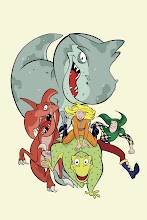
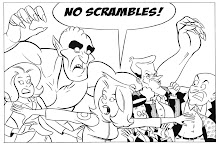
Hey, fans! Here are a pair of posters I produced for the recent 2008 FanExpo Toronto. Dave Sim had suggested that I capitalize on Marvel's Secret Invasion storyline, so I gave it a go. I haven't had this much fun drawing in a long time.

Tuesday, August 12, 2008

I Met The Walrus

For Those who haven't seen it, here it is. PEACE.